

Amid the growing impacts of climate change and rapid urbanization, land subsidence in Ho Chi Minh City has become one of the most critical challenges to sustainable development. This issue was highlighted at the IMRWG 2026 Conference, co-organized by Ho Chi Minh City University of Natural Resources and Environment and the International Mekong River Working Group (IMRWG) on April 20–21, 2026.
Gathering Over 160 International Experts
The IMRWG 2026 Conference brought together more than 160 scientists and experts from both Vietnam and abroad, along with representatives from diplomatic missions such as the U.S. and Italian Consulates, as well as leading research institutions and universities worldwide.
The event focused on urgent issues in Southern Vietnam, particularly in Ho Chi Minh City and the Mekong Delta, including climate change, saltwater intrusion, urbanization pressure, and land subsidence.
Key activities of the conference included:
- Scientific workshop: “Earth Observation and Geospatial Intelligence in Sustainable Development for Urban and Mekong Delta Region”
- Training course: “Remote Sensing and Geospatial Techniques for Water Resource and Ecosystem Management”
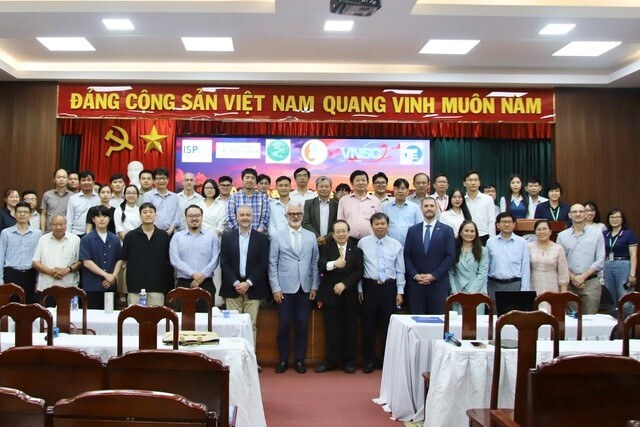
The IMRWG 2026 Conference brought together more than 160 scientists and experts from both domestic and international institutions (By: Uyen Nhi)
Uneven Subsidence, Reaching Up to 5 cm per Year in Some Areas
According to a report by Associate Professor Dr. Le Trung Chon, research using InSAR technology from Sentinel-1 satellites shows that land subsidence in Ho Chi Minh City is uneven, with some areas experiencing rates of up to 5 cm per year.
Identified subsidence “hotspots” include:
- Nha Be District
- Binh Chanh District
- District 7
- Binh Tan District
- District 8
Meanwhile, northern areas such as Cu Chi District show relatively more stability.
Notably, the integration of Persistent Scatterer (PS) and Distributed Scatterer (DS) data improves accuracy, enabling detailed monitoring of subsidence down to specific neighborhoods and even individual points on digital maps.
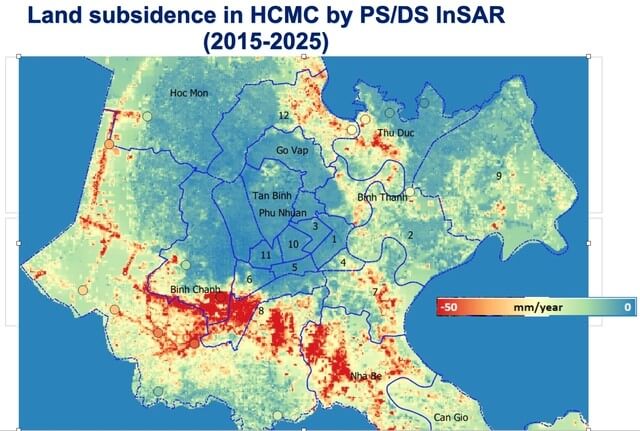
Land subsidence map of Ho Chi Minh City based on PS/DS InSAR technology (2015–2025) (By: Screen captured)

Associate Professor Dr. Le Trung Chon presented research on land subsidence in Ho Chi Minh City and the Mekong Delta at the IMRWG 2026 Conference (By Uyen Nhi)
Not Only Natural Causes: Urban Pressure as a Major Factor
Experts emphasize that subsidence in Ho Chi Minh City is not solely due to natural causes but is significantly influenced by human activities.
Excessive groundwater extraction creates underground voids, which is a key contributor. Additionally, the load from major infrastructure projects such as metro systems and highways increases pressure on weak soil foundations.
According to Dr. Nghiem Van Son (NASA Jet Propulsion Laboratory), land subsidence is common in cities built on soft ground such as Ho Chi Minh City, Bangkok, and Los Angeles. Uneven subsidence, in particular, can severely damage underground infrastructure systems.
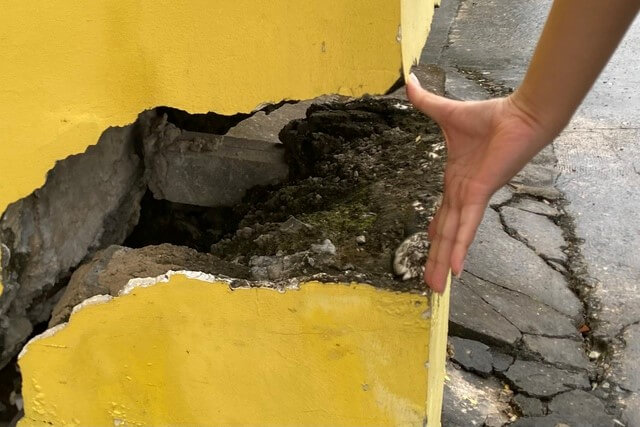
A wall crack as wide as a hand in An Lac Ward—identified as the fastest-subsiding area in Ho Chi Minh City, photographed in September 2025 (By: Thanh Mai)
Towards Sustainable Development Through Technology and Planning
In response to the situation, experts proposed several solutions to adapt to subsidence and promote sustainable development in Ho Chi Minh City and the Mekong Delta:
- Integrating subsidence data into urban and rural planning
- Applying geospatial intelligence in smart urban management
- Continuously updating data for risk forecasting and timely response
- Piloting “sponge city” models suitable for water-based environments
- Developing smart agriculture based on geospatial technologies
Promoting International Cooperation for the Mekong Region’s Future
Beyond being an academic forum, the IMRWG 2026 Conference also plays a crucial role in fostering international collaboration, connecting research resources, and proposing practical solutions for the Mekong region.
Through this conference, experts aim to contribute to the development of long-term strategies to mitigate risks, adapt to climate change, and ensure sustainable development for Ho Chi Minh City in the future.
(Source: Thanh Nien News)